|
2012 U.S. Professor of the Year
Professor, OCW advocate, socio-economic diversity champion, one-pony pedagogy assailant, UDL believer, replicating education-research studies supporter.
|
|
|


|
HOME | NEWS | TEACHING | RESEARCH | STUDENTS | TEXTBOOKS | PUBLICATIONS | NEWS ARTICLES | CONTACT
|
|
Comparing two procedures for assembling steel fulcra in simple-trunnion bascule bridges |
|
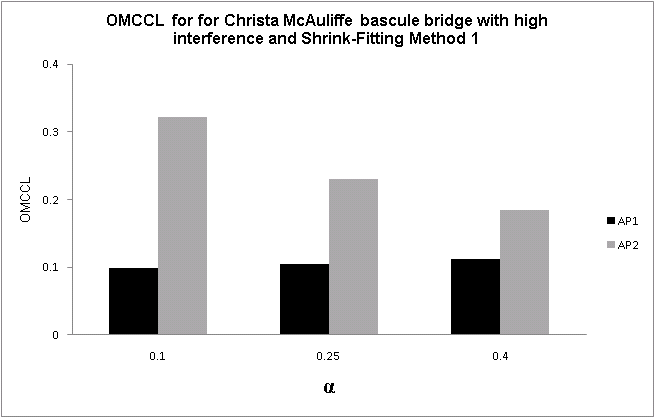
Involving shrink fitting, two procedures for assembling
steel fulcra of simple-trunnion bascule bridges are
quantitatively compared for the likelihood of fracture
during assembly. In assembly procedure called AP1, the
trunnion is shrink fitted into a hub, followed by shrink
fitting the
Related Papers S. Garapati, L. Snyder, A. Kaw, "Comparing Two Procedures for Assembling Steel Fulcra in Simple-Trunnion Bascule Bridges", Bridge Structures, pp. 19-30, Vol 7(1), 2011.
S.H. Garapati, A.Kaw, "Analysis of Heating and Cooling Methods for Assembly of Steel Fulcra in Bascule Bridges", Bridge Structures, pp. 121-133, Vol 8(3-4), 2012. |
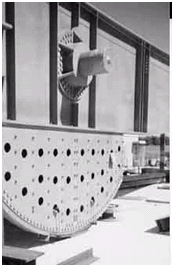 trunnion-hub
assembly into the girder of the bridge. In assembly
procedure called AP2, the hub is shrink fitted into the
girder, followed by shrink-fitting the trunnion in the
hub-girder assembly. A formal design of experiments is
conducted to find the influence of geometrical parameters
such as the radial thickness of the hub, radial
interference, and various shrink-fitting methods on the
design parameter of critical crack length – a measure of
likelihood of fracture. For single-staged shrink-fitting
methods, for high and low hub radial thickness to hub inner
diameter ratio, assembly procedure AP1 and AP2 are
recommended, respectively. For fulcra with low hub radial
thickness to hub inner diameter ratio and where staged
shrink-fitting methods are used, for AP2, cooling the trunnion in dry-ice/alcohol and heating the girder, and for
AP1, cooling the trunnion-hub assembly in dry-ice/alcohol
followed by immersion in liquid nitrogen is recommended. For
fulcra with high hub radial thickness to hub inner diameter
ratio and where staged shrink-fitting methods are used,
cooling the components in dry-ice/alcohol and heating the
girder is recommended for both AP1 and AP2.
trunnion-hub
assembly into the girder of the bridge. In assembly
procedure called AP2, the hub is shrink fitted into the
girder, followed by shrink-fitting the trunnion in the
hub-girder assembly. A formal design of experiments is
conducted to find the influence of geometrical parameters
such as the radial thickness of the hub, radial
interference, and various shrink-fitting methods on the
design parameter of critical crack length – a measure of
likelihood of fracture. For single-staged shrink-fitting
methods, for high and low hub radial thickness to hub inner
diameter ratio, assembly procedure AP1 and AP2 are
recommended, respectively. For fulcra with low hub radial
thickness to hub inner diameter ratio and where staged
shrink-fitting methods are used, for AP2, cooling the trunnion in dry-ice/alcohol and heating the girder, and for
AP1, cooling the trunnion-hub assembly in dry-ice/alcohol
followed by immersion in liquid nitrogen is recommended. For
fulcra with high hub radial thickness to hub inner diameter
ratio and where staged shrink-fitting methods are used,
cooling the components in dry-ice/alcohol and heating the
girder is recommended for both AP1 and AP2.