|
2012 U.S. Professor of the Year
Professor, OCW advocate, socio-economic diversity champion, one-pony pedagogy assailant, UDL believer, replicating education-research studies supporter.
|
|
|

|
HOME | NEWS | TEACHING | RESEARCH | STUDENTS | TEXTBOOKS | PUBLICATIONS | NEWS ARTICLES | CONTACT
|
|
Problem-Centered Approach in a Numerical Methods Course
This paper is an illustration of using a
problem-centered approach in an undergraduate course in numerical
methods. The problem used in the course was first encountered in a
research
Related Papers A.K. Kaw, A.Yalcin, "Problem-Centered Approach in a Course in Numerical Methods", ASCE Journal of Professional Issues and Engineering Education, pp. 359-364, Vol. 134(4), 2008.
S. Garapati, L. Snyder, A. Kaw, "Comparing Two Procedures for
Assembling Steel Fulcra in Simple-Trunnion Bascule Bridges", Bridge
Structures, pp. 19-30, Vol 7(1), 2011.
C. Nguyen, A.K. Kaw, J. Paul,
"Sensitivity Analysis of Cooling Methods and Geometric
Parameters in Assembly Procedure of Bascule Bridge Fulcrums",
The Journal of Strain Analysis for Engineering Design, pp.
337-349, Vol. 42, (2007).
N. Collier, A.K. Kaw, G.H.
Besterfield, M. Rahman, "Benefits of Staged Cooling of Composite
Cylinders in Shrink Fitting", The Journal of
Strain Analysis for Engineering Design, pp. 349-361, Vol. 41 (5), (2006).
A.K. Kaw, G.H.
Besterfield and S. Nichani, "Integrating a Research Problem in a
Course in Applied Elasticity", International
Journal of Mechanical Engineering Education, pp. 232-242, Vol. 32 (3),
(2004).
G.H. Besterfield, A.K. Kaw, S.
Nichani, B. Ratnam, T. Cherukara, M. Denninger "Assembly
Procedures of a Trunnion-Hub-Girder for Bascule Bridges",
Theoretical and Applied Fracture Mechanics, Vol 40, No 2,
pp. 123-134, (2003).
G.H. Besterfield, S. Nichani, A.K.
Kaw, T. Eason, "Full-Scale Testing of Trunnion-Hub-Girder
Assemblies for Bascule Bridges", ASCE Journal of Bridge
Engineering, Vol. 8, No 4., pp. (2003). |
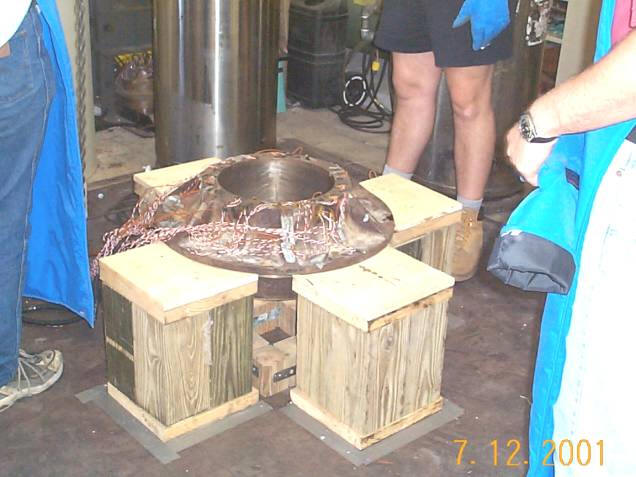 project that related to the assembly procedure of the fulcrum
of bascule bridges. It involved the study of the fulcrum assembly
procedure where a trunnion cooled in a dry-ice/alcohol mixture for
shrink fitting became stuck halfway in the hub before full insertion
could take place. The solution of the problem and its implementation
involved numerical solutions of mathematical procedures taught in a
typical numerical methods course. The effect of the problem-centered
approach in the classroom was quantitatively and qualitatively surveyed
over a two-semester period. The results indicate very high student
satisfaction in helping them: acquire basic knowledge and skills;
reinforce information presented in class, reading assignments, and
problem sets; learn to clearly formulate a specific problem and then
work it through to completion; develop generic higher-order thinking and
problem solving skills; and develop a sense of competence and confidence
and see the relevance of the course material to their major.
project that related to the assembly procedure of the fulcrum
of bascule bridges. It involved the study of the fulcrum assembly
procedure where a trunnion cooled in a dry-ice/alcohol mixture for
shrink fitting became stuck halfway in the hub before full insertion
could take place. The solution of the problem and its implementation
involved numerical solutions of mathematical procedures taught in a
typical numerical methods course. The effect of the problem-centered
approach in the classroom was quantitatively and qualitatively surveyed
over a two-semester period. The results indicate very high student
satisfaction in helping them: acquire basic knowledge and skills;
reinforce information presented in class, reading assignments, and
problem sets; learn to clearly formulate a specific problem and then
work it through to completion; develop generic higher-order thinking and
problem solving skills; and develop a sense of competence and confidence
and see the relevance of the course material to their major.